

Posted on: 01. 30. 26

When we look at a natural gas flame, we see a clean, steady blue burn. It represents energy in its most usable form. However, the journey to that blue flame begins in a much messier place. At the wellhead, natural gas is rarely “pipeline ready.” It is a raw, chaotic mixture of methane, water vapor, heavy hydrocarbons, and various contaminants. If we were to push this raw stream directly into a transmission line, it would wreak havoc. It would clog valves, corrode pipes, and potentially cause catastrophic pressure failures. This is where the vital role of Field Gas Conditioners comes into play.
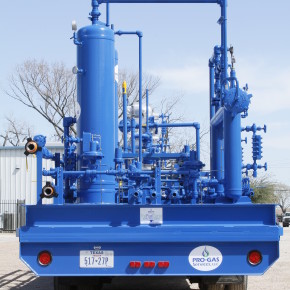
At Pro-Gas, we view gas conditioning not just as a regulatory hurdle, but as the critical gateway between extraction and profitability. Without effective conditioning, the gas remains a stranded asset—valuable in theory but worthless in practice. The industry standard for solving this problem, particularly in remote or satellite fields, is the JT Skid, or Joule-Thomson Skid. These units are the workhorses of the midstream sector. They take the “hot” (high-BTU), wet gas and transform it into a dry, marketable commodity while simultaneously capturing valuable liquid byproducts.
Understanding the mechanics and the economics of these systems is essential for any producer looking to maximize the value of their flow. We are going to explore the physics behind the technology, the operational benefits of deploying these units, and how they turn potential operational headaches into significant revenue streams. We will walk through the process, from the high-pressure inlet to the sales line, and explain why partnering with experts like us for your facility design is the smartest move you can make.
The Science Behind the Solution | The Joule-Thomson Effect
To understand why a JT Skid works, we must first understand the physical principle it is named after: the Joule-Thomson effect. In thermodynamics, this effect describes the temperature change of a real gas or liquid when it is forced through a valve or porous plug while kept insulated so that no heat is exchanged with the environment.
When a gas expands freely — meaning its pressure drops significantly — it typically cools down. This is not a chemical reaction; it is a physical response to pressure changes. The gas molecules, which are packed tightly together under high pressure, are suddenly released. As they move apart, they consume internal energy to overcome the intermolecular forces holding them together. This consumption of energy manifests as a drop in temperature.
In a practical setting within a Field Gas Conditioner, we exploit this phenomenon. We take high-pressure gas and force it through a specific expansion valve (the JT valve). The pressure drop causes the temperature of the gas stream to plummet, often dropping below freezing. This rapid cooling forces the heavier hydrocarbons (like propane, butane, and pentane) and water to condense from a vapor state into a liquid state. Once they are liquids, we can easily separate them from the dry methane gas.
Meeting Pipeline Specifications | The Primary Objective
The primary reason our clients deploy these skids is to meet the strict quality standards set by transmission pipelines. Pipeline operators are the gatekeepers of the energy grid. They have rigorous specifications regarding the Hydrocarbon Dew Point and water content of the gas they accept.
If gas entering a pipeline is too “rich” — meaning it has a high concentration of heavy hydrocarbons — these heavy components can condense into liquids as the gas travels and cools in the underground pipe. This liquid dropout is a nightmare for pipeline integrity. It causes:
- Hydrate Formation: Icy slush that blocks flow.
- Corrosion: Water and contaminants eating away at the steel.
- Slug Flow: Large pockets of liquid that damage compressors.
- Inefficient Combustion: Varying BTU values that disrupt end-user equipment.
By using a JT Skid, we lower the temperature of the gas drastically before it enters the pipeline. This “wrings out” the liquids in a controlled environment. If we cool the gas to -20°F in our skid, we guarantee that no liquids will form in the pipeline unless the pipeline gets colder than -20°F (which is virtually impossible in buried lines). This process ensures the gas meets the Hydrocarbon Dew Point spec, guaranteeing a safe and continuous flow into the sales line.
Turning Waste Into Revenue | NGL Recovery
While meeting pipeline specs is a necessity, the recovery of Natural Gas Liquids (NGLs) is an opportunity. In the early days of the industry, these heavy hydrocarbons were often flared off or viewed as a nuisance. Today, we know that NGLs—often referred to as “Y-Grade”—are liquid gold.
Propane, butane, and natural gasoline are valuable commodities with their own distinct markets. By using Field Gas Conditioners, we do not just remove these liquids to clean the gas; we capture them to sell them. The JT Skid acts as a localized processing plant.
Imagine a well producing gas that is 1300 BTU. This is too “hot” for a standard 1000-1050 BTU pipeline. If you try to sell it as is, you might be rejected or penalized. By running it through our equipment, we strip out the heavy BTUs (the liquids). The result is two revenue streams:
- Residue Gas: Methane that is now at the correct BTU specification (approx. 1000 BTU) and ready for the pipeline.
- NGLs: A tank full of high-value liquids that can be trucked out and sold to petrochemical plants or fractionation facilities.
We have seen cases where the revenue from the recovered NGLs actually exceeds the revenue from the natural gas itself. This transforms the economics of a marginal well into a highly profitable asset.
Anatomy of a Pro-Gas JT Skid
We design our equipment for durability and ease of operation. While the science is complex, the operational flow is straightforward. Let’s walk through the key components of a standard unit.
1. The Heat Exchanger
Before the gas hits the expansion valve, it passes through a high-efficiency heat exchanger. This is a “gas-to-gas” exchanger. We use the cold gas that has already been processed to pre-cool the warm incoming gas. This heat integration makes the system incredibly efficient, requiring less energy to achieve the desired temperature drop.
2. The High-Pressure Separator
Often, the inlet gas contains free water or liquids that have already condensed. We run the stream through a high-pressure separator first to knock out these bulk liquids. This protects the heat exchanger and the JT valve from erosion or freezing.
3. The JT Valve
This is the heart of the skid. It is a control valve that creates the pressure drop. By adjusting this valve, operators can control exactly how much the pressure falls, and consequently, how cold the process gets. Precision here is key.
4. The Low-Temperature Separator (LTS)
After the expansion valve, the gas is extremely cold—often well below zero degrees Fahrenheit. At this temperature, the NGLs and water mist fall out of the gas stream. The LTS is a vessel designed to facilitate this separation. The liquids fall to the bottom, and the dry, cold gas rises to the top to head back through the heat exchanger (to cool the incoming gas) and then out to the sales line.
5. Methanol Injection System
When we work with freezing temperatures and water, we risk forming hydrates—solid ice-like structures that can block pipes in minutes. To prevent this, our skids are equipped with methanol injection pumps. Methanol acts like antifreeze, lowering the freezing point of the water and ensuring the liquids remain fluid enough to be drained.
Operational Flexibility and Mobility
One of the defining features of the upstream oil and gas sector is its transient nature. Wells decline. Fields deplete. New discoveries are made. Building a permanent, concrete-foundation gas plant for a single well or a small pad is often not economically viable. This is where Pro-Gas shines.
Our Field Gas Conditioners are modular and skid-mounted. This means they are built on a steel frame that can be loaded onto a truck and moved.
- Rapid Deployment: We can have a skid on-site and operational in a fraction of the time it takes to build a permanent facility.
- Scalability: If production increases, we can swap the skid for a larger one or add a parallel unit. If production declines, we can downsize to match the flow, maintaining efficiency.
- Asset Utilization: When a well runs dry, the asset isn’t lost. We simply disconnect the skid and move it to a new location. This mobility preserves your capital investment.
This flexibility is crucial for “stranded gas” scenarios—locations that are too far from a major processing plant to justify a pipeline connection without prior conditioning. By conditioning at the wellhead, we make the gas transportable.
Maintenance and Optimization
Owning or leasing a JT Skid is not a “set it and forget it” operation. To maintain the BTU Reduction efficiency, regular attention is required. We advocate for a proactive maintenance schedule.
Glycol vs. Methanol
While methanol is great for freeze protection, some larger or more complex units might use ethylene glycol injection. Managing the regeneration of this glycol is critical. If the glycol becomes saturated with water, it loses its ability to inhibit freezing, and the LTS can freeze up, shutting down production.
Filter Changes
The gas coming from the ground is dirty. Filters catch sand, scale, and paraffins. If these filters clog, the pressure differential across the skid changes, throwing off the delicate thermodynamic balance we are trying to maintain. We recommend monitoring differential pressure gauges daily and changing filters the moment they show resistance.
Liquid Level Controllers
The dump valves on the separators are the only thing stopping your valuable NGLs from flooding the gas line or your gas from blowing out the liquid line. We check these pneumatic or electric controllers regularly to ensure they are snapping open and closed correctly. A stuck dump valve can result in a massive loss of product or environmental containment issues.
Environmental Compliance and Emissions
In the modern regulatory landscape, environmental stewardship is non-negotiable. Field Gas Conditioners play a massive role in reducing the carbon footprint of oilfield operations.
Without the ability to condition and sell gas, operators are often forced to flare it. Flaring converts methane to CO2, but it is still a waste of resources and a source of emissions. By installing a JT Skid, we capture that gas. We turn a waste stream into energy.
Furthermore, our skids are designed with closed-loop systems where possible. The pneumatic controllers can be instrumented to run on compressed air rather than natural gas, eliminating the “bleed” of methane into the atmosphere. We also focus on leak-free connections. Minimizing fugitive emissions is a priority for us and for the agencies that regulate our clients.
The Economics Of BTU Reduction
Let us break down the financial impact of BTU Reduction with a hypothetical scenario.
Suppose you have a well producing 1 MMcf/d (one million cubic feet per day) of gas.
- Raw Gas: 1300 BTU.
- Pipeline Limit: 1050 BTU.
Without conditioning, you have 0 revenue because the pipeline won’t take it. You might have to flare it (losing money and risking fines) just to produce the oil.
With a JT Skid, we process that stream.
- Residue Gas: You now have roughly 0.85 MMcf/d of 1000 BTU gas. This is sold at market gas prices.
- NGL Yield: That “lost” volume (0.15 MMcf/d equivalent) is actually recovered as liquids. Depending on the richness (GPM – Gallons Per Thousand), you might recover 3,000 to 5,000 gallons of NGLs per day.
- Pricing: NGLs often trade at a premium to dry gas on a thermal basis.
Suddenly, the skid is paying for itself in a matter of months. We help our clients run these numbers constantly. The “shrink” in gas volume is not a loss; it is a conversion to a higher-value product.
Troubleshooting Common Challenges
Even the best equipment faces challenges. Here are a few common issues we see in the field and how we address them.
1. Variable Flow Rates
Wells often “slug” or flow inconsistently. A JT Skid relies on a steady pressure drop to maintain temperature. If the inlet pressure fluctuates wildly, the temperature will swing, causing inconsistent separation. We solve this by installing inlet pressure regulators or “slug catchers” upstream of the skid to smooth out the flow.
2. Paraffin Build-up
In some fields, the oil contains heavy waxes. As the gas cools in our heat exchanger, these waxes can solidify and coat the tubes, ruining heat transfer efficiency. In these cases, we may implement a chemical injection program or design the exchanger with specific metallurgy and flow paths to minimize fouling.
3. Hydrate freezing in the JT Valve
If the methanol pump fails, the JT valve is the first place ice will form due to the high velocity and low temperature. The symptoms are a sudden loss of flow and a spike in inlet pressure. The fix is immediate methanol application and heat, but the prevention is a robust pump maintenance schedule.
Why Choose Pro-Gas?
The market is flooded with generic equipment. What sets Pro-Gas apart is our application engineering. We do not just grab a skid off the yard and hope it works. We analyze your specific gas analysis. We look at your pressure, your temperature, and your composition.
We model the process using advanced simulation software to predict exactly how the gas will behave at different pressures. We determine the optimal operating point to maximize NGL recovery without freezing the line.
Our fleet of Field Gas Conditioners is maintained to the highest standards. When you rent or buy from us, you are getting a unit that has been pressure-tested, inspected, and upgraded with modern controls. We also provide the training your lease operators need. A machine is only as good as the person turning the valves, so we invest time in education.
The oil and gas industry is a complex machine with millions of moving parts. Within that machine, the Field Gas Conditioner or JT Skid is a critical component that bridges the gap between the raw chaos of the earth and the structured requirements of the market. It ensures safety, ensures compliance, and most importantly, ensures profitability.
By harnessing the physics of the Joule-Thomson effect, we allow operators to control their production quality precisely. We turn high-BTU problems into NGL profits. We protect pipelines from corrosion and hydrates. We allow energy to flow to the homes and businesses that need it.
At Pro-Gas, we are dedicated to providing the most reliable, efficient, and flexible processing solutions in the industry. Whether you are dealing with a new high-pressure discovery or trying to squeeze the last bit of value from a declining field, we have the technology and the expertise to make it happen. Let us handle the conditioning so you can focus on the production.
Do not let pipeline specifications bottleneck your production. Maximize your NGL revenue and ensure seamless operations with our advanced conditioning equipment. Contact Pro-Gas today to request a quote or a simulation of your well stream. Let’s optimize your facility together.
FAQ
Q. What is the difference between a JT Skid and a Mechanical Refrigeration Unit (MRU)?
A JT Skid uses the pressure drop of the gas itself (the Joule-Thomson effect) to achieve cooling. It requires high inlet pressure to work effectively but has fewer moving parts. A Mechanical Refrigeration Unit (MRU) uses an external compressor and refrigerant (like propane or freon) to cool the gas. MRUs are more complex and expensive but are necessary when the inlet gas pressure is too low to create a sufficient temperature drop via expansion alone.
Q. How does High-Btu Gas affect pipeline safety?
High-Btu Gas contains heavy hydrocarbons that can condense into liquids within the pipeline as the gas cools. These liquids can cause internal corrosion, block gas flow (via hydrate formation), and damage compressors. Furthermore, liquid slugs can overwhelm the separation equipment at the receiving end, leading to containment breaches. Pipelines enforce strict BTU and dew point limits to prevent these integrity risks.
Q. Can a Field Gas Conditioner handle sour gas (H2S)?
Standard Field Gas Conditioners are designed primarily for sweet gas. If the gas contains Hydrogen Sulfide (H2S), the equipment requires special metallurgy (NACE compliant materials) to prevent sulfide stress cracking. Additionally, while the skid can remove water and hydrocarbons, it is not designed to remove the H2S itself; an Amine plant or scavenger system would be required upstream or downstream to treat the toxicity of the gas.


