
Posted on: 05. 10. 25

At Pro-Gas LLC, we are at the forefront of the dynamic DFW NGL technology sector, constantly evolving to meet the growing demands of the energy industry. Natural Gas Liquids (NGLs), including ethane, propane, butanes, and natural gasoline, are vital to numerous aspects of modern life, serving as essential fuels and feedstocks for a vast array of products, from plastics to clean-burning energy sources. The escalating global and local need for these versatile resources necessitates continuous advancements in our methods for natural gas liquid separation.
While traditional separation techniques have been industry mainstays for decades, the need to process increasingly complex gas streams, adhere to stricter environmental regulations, enhance operational flexibility, and improve project economics drives the demand for innovation.
We are witnessing a significant wave of technological progress, from intelligent enhancements to cryogenic expansion processes to the increasing adoption of groundbreaking solutions like membrane separation NGL technology, advanced adsorption NGL technology, and sophisticated hybrid NGL recovery systems.
Our focus is on achieving enhanced NGL recovery, boosting energy efficiency NGL separation, and developing more robust and cost-effective NGL separation strategies for the future.
The Indispensable Role of NGLs and Efficient Separation
To truly grasp the significance of innovations in NGL processing, we must recognize the immense value of NGLs. These are not mere byproducts but critical commodities that fuel economic growth, generate employment, and support numerous downstream industries both within Texas and globally.
Consider the individual components:
- Ethane (C2): The primary feedstock for ethylene crackers, producing ethylene, the foundation of the plastics industry.
- Propane (C3): A versatile clean-burning fuel for heating and cooking, and a key feedstock for propylene, another vital building block for plastics.
- Butanes (C4 – n-butane and iso-butane): Used in gasoline blending, synthetic rubber production, and as a fuel source.
- Natural Gasoline (C5+ or Pentanes Plus): A component in motor fuel blending, a diluent for heavy crude oil, and an industrial solvent.
Efficient natural gas liquid separation is crucial for meeting natural gas quality specifications for pipeline transportation and end-use. Removing NGLs prevents condensation and two-phase flow issues, protects downstream equipment, and ensures a consistent heating value of the sales gas. For producers in the competitive DFW region, enhanced NGL recovery directly translates to increased revenue and improved profitability.
Foundations of NGL Recovery and the Impetus for Innovation
Understanding established NGL recovery technology provides context for current advancements. While older methods like lean oil absorption and simple refrigeration have been used, the cryogenic expansion process has become the dominant technology for high NGL recovery rates. This process chills the inlet natural gas stream to extremely low temperatures, causing NGLs to condense and separate from the methane-rich gas.
Key equipment in a cryogenic NGL plant includes:
- Inlet Separation and Pre-treatment: Removing liquids, solids, acid gases, and water vapor.
- Heat Exchangers: Efficiently cooling incoming gas against outgoing cold streams.
- Turboexpander-Compressor: Expanding high-pressure gas to achieve significant cooling and power residue gas recompression.
- Cold Separator: Separating condensed NGLs from cold residue gas.
- Fractionation Train: Distilling the mixed NGL stream into individual components.
Process configurations like the Gas Subcooled Process (GSP) and Recycle Split Vapor (RSV) have been developed to optimize recovery rates. However, traditional cryogenic plants are energy-intensive, have a large footprint, require significant capital investment, and can face challenges with turndown flexibility and CO2 freezing. These limitations drive the continuous pursuit of more efficient and cost-effective NGL separation methods.
Key Technological Advancements in NGL Processing
The NGL industry is a hub of ongoing research and development, constantly pushing the boundaries of natural gas liquid separation. These innovations in NGL processing offer the potential for higher recovery rates, reduced energy consumption, minimized environmental impact, and improved project economics. At Pro-Gas LLC, we are committed to understanding and implementing these advanced DFW NGL technology options.
Refining the Classic Enhancements in the Cryogenic Expansion Process
The cryogenic expansion process continues to be a focus of innovation. Advanced process cycles, often proprietary designs, utilize complex internal refrigerant loops and optimized heat exchange networks to achieve higher thermodynamic efficiencies, pushing propane recovery beyond 99% and ethane recovery into the high 90s percentile. This enhanced NGL recovery directly benefits operations in liquids-rich DFW basins.
Advanced heat integration, employing sophisticated heat exchanger networks like brazed aluminum plate-fin (BAHX) and printed circuit heat exchangers (PCHE), maximizes thermal energy recovery, improving overall energy efficiency NGL separation.
Continuous improvements in turboexpander design, including enhanced aerodynamics and active magnetic bearing (AMB) systems, lead to higher efficiencies and reduced maintenance. Variable inlet guide vanes (IGVs) also improve turndown capability. Pro-Gas LLC actively incorporates these cryogenic advancements to provide best-in-class performance in the DFW NGL technology landscape.
Membrane Separation NGL Technology
Membrane separation NGL technology is a rapidly evolving field utilizing semi-permeable membranes to selectively separate gas components based on differences in solubility and diffusivity. These membranes, often made from advanced polymers, can offer significantly lower energy consumption compared to cryogenics, especially for bulk removal of components like CO2 or moderate NGL recovery. Membrane systems are often modular, making them suitable for remote locations, offshore platforms, or phased capacity additions, and can simplify operations.
Current applications include pre-treating natural gas for CO2 and H2S removal and enriching lean gas streams. While membranes may not always achieve the deep NGL recovery of optimized cryogenic plants, they are invaluable in hybrid NGL recovery systems. For instance, a membrane unit could perform initial CO2 removal and NGL enrichment at a remote DFW well site, reducing the load on a larger, centralized facility. Challenges remain in balancing permeability and selectivity and addressing membrane aging.
Modern Adsorption NGL Technology
Adsorption NGL technology is experiencing a resurgence due to advancements in adsorbent materials like zeolites, activated carbon, and metal-organic frameworks (MOFs), and optimized process cycles. This technology uses solid materials with a high affinity for specific NGL molecules, selectively adsorbing them from the gas stream. The process involves cycles of adsorption and regeneration, with regeneration achieved through pressure swing adsorption (PSA), temperature swing adsorption (TSA), or vacuum swing adsorption (VSA).
Modern adsorption offers high selectivity for specific NGL components and can achieve deep dehydration of natural gas. While energy requirements for thermal regeneration and potential adsorbent degradation are considerations, adsorption technology finds valuable applications in peak shaving plants and high-purity NGL recovery, and is increasingly integrated into hybrid NGL recovery systems. New adsorbent materials promise to further enhance the efficiency of this technique.
Hybrid NGL Recovery Systems
Hybrid NGL recovery systems strategically combine two or more separation technologies, such as cryogenic expansion, membrane separation NGL modules, and adsorption NGL technology units, to leverage their individual strengths and mitigate weaknesses. This integrated approach often yields superior overall plant performance and improved project economics.
A common configuration involves using membrane separation upstream of a cryogenic process for bulk CO2 and H2S removal, reducing the load and complexity of the cryogenic unit. Membranes can also pre-concentrate NGLs from lean gas streams.
Another example is combining adsorption with cryogenics for ultra-deep dehydration, allowing the cryogenic unit to operate at lower temperatures for higher NGL recovery. These custom-designed systems optimize cost-effective NGL separation and contribute to reducing emissions NGL processing by minimizing energy consumption and maximizing hydrocarbon recovery. The flexibility of combining modules also supports modular NGL plants.
Optimizing the Entire Chain — From Fractionation to Digital Control
Innovation in natural gas liquid separation extends beyond core recovery units to encompass the entire process chain, including NGL fractionation and plant design and operation. These system-wide enhancements are crucial for maximizing value and sustainability.
Advanced Fractionation | Driving NGL Purity Improvements
Advanced NGL fractionation technologies are essential for achieving the high NGL purity improvements required by the market. Innovations include more efficient column internals like advanced distillation trays and structured packings, which improve mass transfer and reduce energy consumption.
Dividing Wall Columns (DWCs), which perform the work of multiple conventional columns in a single shell, offer significant energy and capital cost savings. Heat pump assisted distillation is another technique gaining traction to reduce the energy footprint of NGL fractionation. Achieving polymer-grade purity for ethane and propane is critical for petrochemical feedstocks, and these advanced techniques are vital for meeting stringent specifications economically.
Agility and Scalability | Modular NGL Plants
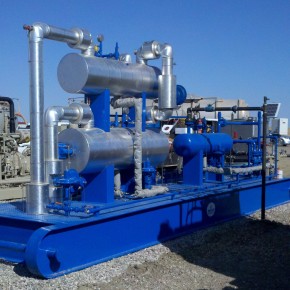
Modular NGL plants represent a significant advancement in how NGL processing facilities are designed and constructed. Major sections are pre-fabricated as skid-mounted modules in controlled environments, then transported for final assembly on-site. This approach offers numerous benefits, including faster project schedules, reduced on-site construction work, higher quality control, improved safety, and excellent scalability. Modular NGL plants are particularly advantageous for remote locations, smaller gas producers, and phased development projects, contributing to more cost-effective NGL separation. Pro-Gas LLC actively evaluates and deploys these agile solutions.
Data-Driven Decisions | Digitalization in NGL Plants
Digitalization in NGL plants leverages real-time data, advanced analytics, automation, and interconnected systems to optimize plant design, operation, and maintenance. Advanced Process Control (APC) systems use sophisticated models to continuously adjust operating parameters, maximizing NGL recovery and minimizing energy consumption.
Artificial Intelligence (AI) and Machine Learning (ML) are used for predictive maintenance, dynamic process optimization, and advanced anomaly detection. The “Digital Twin,” a virtual replica of the physical plant, is used for operator training, testing new strategies, performance analysis, and design optimization. These digital tools enhance energy efficiency NGL separation, improve enhanced NGL recovery, and contribute to reducing emissions NGL processing through tighter control and proactive fault detection.
Greener Processing | Reducing Emissions NGL Processing
A crucial driver of innovations in NGL processing is the increasing focus on environmental stewardship. Reducing emissions NGL processing is a core goal, driven by regulatory pressure and corporate responsibility. Improved energy efficiency NGL separation directly lowers fuel consumption and greenhouse gas emissions. Membrane separation NGL technology can reduce or eliminate the need for chemical solvents.
Enhanced NGL recovery minimizes hydrocarbon losses through flaring and venting. Digitalization in NGL plants enables tighter operational control, preventing process upsets and fugitive emissions. Advanced recovery schemes can also process previously uneconomic gas streams, reducing flaring.
Pro-Gas LLC integrates environmental considerations into our DFW NGL technology and Pro-Gas LLC NGL solutions, providing economically attractive and environmentally sound options. We also consider water usage in plant operations.
The Future of Natural Gas Liquids | Pro-Gas
The field of natural gas liquid separation technology is dynamic, marked by continuous improvement and groundbreaking advancements. At Pro-Gas LLC, we have explored the remarkable evolution driven by the need for greater efficiency and sustainability. From the refinement of cryogenic expansion to the emergence of membrane separation NGL technology, advanced adsorption NGL technology, and hybrid NGL recovery systems, the industry’s capabilities are expanding rapidly. Coupled with advancements in NGL fractionation, modular plant design, and digitalization, these developments are transforming NGL recovery and purification.
The benefits for our clients and the industry are significant: enhanced NGL recovery, improved energy efficiency NGL separation, higher NGL purity improvements, and more cost-effective NGL separation solutions. At Pro-Gas LLC, we are proud to be your partner in navigating this complex landscape, providing cutting-edge Pro-Gas LLC NGL solutions backed by expertise and a commitment to service. We are excited to contribute to a more efficient, profitable, and sustainable energy future.
Ready to optimize your natural gas stream with the latest NGL recovery technology? Contact Pro-Gas LLC today to discuss how our expertise in innovations in NGL processing and efficient modular NGL plants can benefit your DFW operations. Reach out today. Let’s explore your tailored, cost-effective NGL separation solutions together!
FAQ
Q. What are the main benefits of pursuing innovations in NGL processing for my DFW operations?
For your DFW NGL technology needs, adopting innovations in NGL processing offers enhanced NGL recovery, improved energy efficiency NGL separation, better NGL purity improvements, and more cost-effective NGL separation overall. Pro-Gas LLC specializes in implementing these advanced solutions.
Q. How does membrane separation NGL technology differ from the traditional cryogenic expansion process?
Membrane separation NGL technology uses selective membranes to separate NGLs based on permeability, often at near-ambient temperatures with lower energy consumption for certain applications. The cryogenic expansion process chills natural gas to very low temperatures to condense and separate NGLs. While cryogenics excels in high recovery, especially for ethane, membranes offer advantages in energy efficiency, footprint, and modularity, and are often used in hybrid systems.
Q. Are modular NGL plants a viable option for smaller gas producers in Texas?
Yes, modular NGL plants are highly viable for small to mid-sized gas producers in Texas, including the DFW area. They offer faster deployment, reduced on-site construction, improved quality control, and scalability, making them a cost-effective NGL separation solution, particularly for smaller resources or phased development. Pro-Gas LLC provides expertise in these efficient solutions.


