

Posted on: 07. 07. 26
Operating a remote wellhead comes with its own unique set of challenges. You’re working with untreated wellstream fluid straight from the earth, which is rarely in a usable condition. Unless corrected, many natural gas applications produce liquid dropout in the lines that freezes up equipment, alters your gas spec, and results in costly downtime.
Luckily, there’s a single piece of equipment that can easily treat your gas on-site without adding electrical complexities. Enter the JT skid.
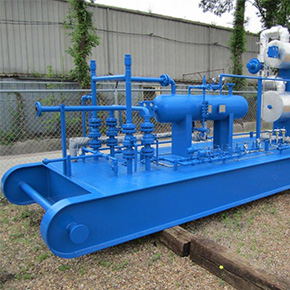
A JT skid, short for Joule-Thomas skid, allows operators to treat their gas at the wellhead using simple thermodynamic principles. The skid reliably drops incoming pressure to encourage liquids to drop without any external refrigeration sources or chemical injections. It’s a game-changer for any field operations manager looking to unlock precious NGL recovery and streamline their fuel gas.
What is a JT Skid? | Treating Natural Gas With Joule-Thomson Expansion
A JT skid is a mobile process unit that conditions incoming natural gas flows by reducing temperature through pressure reduction. This occurs thanks to something called the Joule-Thomas effect. When pressurized, gas expands quickly through a valve or obstruction into a chamber with lower pressure; the temperature of the gas decreases significantly.
The result? Heavy hydrocarbons within your gas stream, like propane, butane, and pentane, drop out into liquid form. This is referred to as natural gas liquids, or NGL, dropout. The JT skid then collects these liquids and removes them from the gas stream. What you have left is a dry residue gas that either meets pipeline specifications or can be used as clean-burning engine fuel.
Field production teams love JT skids because the process feeds into itself. There’s no need for external power as your system uses the pressure from your high-pressure inlet gas to facilitate cooling. It’s one of the simplest, most dependable forms of gas conditioning for remote sites with limited or no electrical access.
Watch the Thermodynamics of Natural Gas Liquids Dropout
Step by step, the process looks something like this:
Step 1 | Bulk Liquid Removal
Gas enters the JT skid and immediately passes through an inlet separator. This removes any bulk liquid hydrocarbons or water that traveled up the wellbore with your produced gas. If not removed at this stage, wet gas can cause serious freezing problems within the JT skid.
Step 2 | Gas-to-Gas Heat Exchanger
The inlet separator directs warm, high-pressure inlet gas into a vessel known as the gas-to-gas heat exchanger. As the name implies, waste treated gas that has already gone through the expansion process runs directly counter to the warm inlet gas. This step pre-cools the warm incoming gas using cold treated gas and optimizes your unit’s thermal efficiency.
Step 3 | JT Valve
The now pre-cooled high-pressure inlet gas is reduced in pressure by expanding through the JT valve. The molecules inside the valve experience a dramatic decrease in pressure. To compensate for this reduction, they steal thermal energy from the rest of the stream, chilling the incoming gas. As soon as the gas hits this chamber, NGL dropout occurs, producing a fog of cold-treated gas and condensed hydrocarbons.
Step 4 | NGL Separator
From here, the cold mixture is pushed into a low-pressure separator vessel. Naturally, NGLs fall to the bottom of this tank where they are skimmed off and stored as an incredibly valuable byproduct. The cold, dry outlet gas cycles back through the gas-to-gas heat exchanger and further cools the warm incoming inlet gas. Finally, the dry gas flows out of the JT skid and into your sales line or fuel destination.
Tip | Keep an Eye on Your ΔP
Pay attention to the pressure differential between your inlet separator and JT valve. If you see a ΔP drop but not a corresponding temperature drop, you are likely building up hydrates or ice in your JT valve. Make sure your upstream dehydration or chemi-injection package is operating properly to avoid these temperature freezes.
Benefits of Fuel Quality Improvement | Efficient, Reliable Operations
Raw, wet gas is tough on any internal combustion engine. High BTU gas is overly rich in heavy hydrocarbons that cause serious engine damage when burned. These can include engine knocking, fouled spark plugs, and melted pistons.
Fuel quality improvement occurs when you install a JT skid at your wellhead. JT skids drop your gas’s hydrocarbon dew point, leaving you with a clean, consistent feed of methane to burn as fuel. Not only will your site engines enjoy longer runtimes between maintenance, you’ll also keep costly equipment failures at bay.
Fewer interruptions translates to happy engineers and a significant increase in overall equipment runtime. Plus, selling NGL only adds to your bottom line.
When To Use a JT Skid | Applications for Clean Fuel Gas
Installing JT skids isn’t always necessary, but they become critical at sites showing any of the symptoms below. If your operation is experiencing one or more of the following issues, it’s time to consider a JT skid.
- Your gas stream is being rejected by your pipeline company for high-Btu content or hydrocarbon liquids
- You’re finding liquid accumulation in your field compression equipment or generator sets
- You produce rich (high HP) gas from a new well
- You have remote power needs that require clean burning gas from onsite generators
Quick Quiz: Could Your Operation Benefit from a JT skid?
- Does your wellhead flow currently operate above 800PSI?
- Are you receiving penalty notices or being shut in by your pipeline company due to high BTU gas? Hydrocarbon dew point exceedences?
- Do your field compressors experience accelerated maintenance due to rich fuel gas?
If you answered “Yes” to two or more of the above questions, you’re a perfect JT skid candidate. Adding a JT skid to your site will solve your compliance issues and create an instant revenue stream from recovered NGL.
Contact Pro-Gas LLC | Stay Ahead of the Game
There’s no reason wellhead natural gas can’t be conditioned without expensive chemical treatments or energy intensive refrigeration systems. JT skids create a world of opportunity for operators looking to improve their product without breaking the bank. Keep liquid dropout off your checklist and protect your field equipment by running clean gas through your operation. Proper gas specification starts at the wellhead and JT skids let you take control.
Taking care of your wellhead starts with implementing durable equipment that can withstand the rigors of field conditions. Pro-Gas LLC specializes in lightweight, high output gas conditioning solutions that keep your engines running and protect your expensive downstream assets. Our knowledgeable staff works with your field engineers to assess your gas specs, project potential liquid recovery volumes, and design a customized JT skid system for your application. We bring decades of industry experience and cutting edge support to keep your production online and profitable. Speak with a Pro-Gas representative today to maximize wellhead efficiency.
FAQ
Q. How can a JT skid cool incoming gas if it doesn’t use external power?
- JT skids utilize the Joule-Thomas effect. As gas expands through the JT valve, it begins to cool significantly.
Q. What’s the purpose of natural gas liquids dropout?
- NGL dropout takes rich natural gas and removes heavy hydrocarbons. The result is a much leaner fuel gas that won’t accumulate liquids in your pipeline.
Q. How does improving your fuel gas quality help my operations?
- Improving your gas quality by installing a JT skid decreases the likelihood of engine problems in your field equipment. Rich fuel gas can lead to engine knocking and wear on your spark plugs.


