
Posted on: 02. 19. 26

The path from the wellhead to a high-speed engine is fraught with challenges that can undermine the performance of your most expensive assets. At Pro-Gas, we have seen how raw, untreated gas can wreak havoc on compressor engines and turbines, leading to costly derating, frequent maintenance, and lost revenue.
To combat these issues, we focus on the implementation of JT skids — sophisticated systems that utilize the Joule-Thomson effect to transform raw streams into high-quality fuel. By adopting new JT designs, we provide our clients with the tools necessary to produce enhanced fuel gas that burns cleaner and protects downstream equipment.
In this guide, we will explore the mechanics of these systems, the specific innovations that set our technology apart, and the tangible benefits of utilizing fuel gas that has been precision-conditioned. Let’s look at how we can optimize your operations and turn a potential liability into a profitable asset.
Understanding the Mechanics | The Role of JT Skids
At its core, a Joule-Thomson system is an elegant application of thermodynamics. The process relies on the fact that when a real gas expands from a high-pressure environment to a lower-pressure one without heat exchange, its temperature drops. This cooling is the engine that drives NGL recovery and conditioning.
The Process Flow of Modern JT Skids
- Inlet Filtration and Separation | Before the gas enters the primary thermal components, it passes through an inlet scrubber. This step removes bulk liquids and solids that could foul the heat exchangers or the JT valve itself.
- Gas-to-Gas Heat Exchange | To maximize efficiency, we utilize the cold, processed gas exiting the system to pre-chill the incoming high-pressure stream. This recuperative cooling is essential for reaching the low temperatures required for heavy hydrocarbon condensation.
- The Joule-Thomson Valve | This is where the magic happens. The pre-chilled gas is forced through a specialized expansion valve. As the pressure drops—typically by 500 psi or more—the temperature plummets, often reaching as low as -50°F.
- Low-Temperature Separation | The resulting two-phase mixture enters a cold separator. Here, the heavier hydrocarbons (NGLs) and water condense into liquids and are collected at the bottom, while the lean, dry gas exits the top.
- Warming and Delivery | The cold residue gas returns through the heat exchanger, absorbing heat from the inlet gas. This warms the gas back up to a safe operating temperature before it is delivered as enhanced fuel gas to your engines.
Innovations in New JT Designs | Pushing the Limits of Efficiency
Standard, off-the-shelf equipment often falls short when dealing with the varied gas compositions found in modern production basins. Our new JT designs are built with flexibility and extreme performance in mind. We don’t believe in a one-size-fits-all approach; instead, we tailor the hardware to the specific chemistry of your well.
Advanced Materials and Construction
In many regions, we encounter “sour” gas containing high levels of $H_2S$ or $CO_2$. Standard materials would succumb to corrosion within months. Our latest designs incorporate NACE-compliant metallurgy and specialized coatings that ensure the longevity of the JT skids even in the harshest environments.
Precise Pneumatic and Electronic Control
Automation is the key to consistent gas quality. Our systems feature sophisticated PLC-based controls that monitor the pressure drop and temperature in real-time. This allows the system to adjust the “hot gas bypass” automatically, ensuring that the outlet gas remains within the required BTU range regardless of fluctuations in the inlet stream. This level of precision is what differentiates basic conditioning from the production of truly enhanced fuel gas.
Modular and Portable Footprints
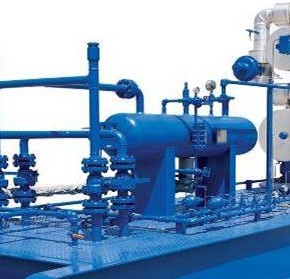
In the fast-paced oil and gas industry, the ability to deploy and redeploy assets is a competitive advantage. Our new JT designs are entirely skid-mounted and self-contained. This “plug-and-play” capability means that once the site is prepared, the unit can be integrated into your infrastructure and started up in a fraction of the time required for traditional plants.
Impact on Fuel Gas Quality — Why It Matters
Using untreated gas as fuel is a gamble. High-BTU gas — rich in propane, butane, and pentane — burns “hot” and can cause detonation or knocking in high-speed engines. This leads to a mandatory “derating” of the engine, meaning you cannot run the equipment at its full rated horsepower.
Benefits of Enhanced Fuel Gas
- Increased Horsepower | By removing the “heavies” and lowering the BTU value, we allow your engines to run at their maximum capacity. This translates directly to higher throughput and increased revenue.
- Reduced Emissions | Leaner gas burns more completely and cleanly. This reduction in Volatile Organic Compounds (VOCs) helps your facility stay compliant with increasingly strict environmental regulations.
- Lower Maintenance Costs | Clean, dry fuel gas prevents the buildup of carbon deposits and reduces the wear and tear on pistons, valves, and liners. This extends the intervals between overhauls and reduces unplanned downtime.
- NGL Monetization | The liquids captured by the JT skids are not waste. These Natural Gas Liquids (NGLs) are valuable commodities that can be sold, often providing enough revenue to pay for the equipment itself in a very short period.
A Step-by-Step Guide to Implementing a Pro-Gas JT Solution
If you are ready to upgrade your gas conditioning strategy, we follow a rigorous process to ensure the solution matches your needs perfectly.
- Gas Analysis | We begin by taking a detailed sample of your raw gas. Understanding the exact molar percentages of methane through heptane, as well as contaminants, is the first step in the design process.
- Process Simulation | Using advanced modeling software, we simulate the performance of various new JT designs against your gas analysis. This allows us to predict NGL recovery rates and the final BTU of your enhanced fuel gas.
- Sizing and Selection | Based on your flow rate requirements—whether it is 500 MCFD or 3,000+ MCFD—we select the appropriate skid size and heat exchanger configuration.
- Site Integration | Our team assists with the layout and connection to your existing infrastructure. Because our JT skids are self-contained, this process is streamlined and efficient.
- Commissioning and Training | Once installed, we oversee the startup and provide training for your operators to ensure they are comfortable with the pneumatic controls and methanol injection systems used for hydrate prevention.
Economic Advantages | Turning Cost into Profit
Historically, gas conditioning was viewed merely as a necessary expense. However, with the right JT skids, the narrative changes. By extracting NGLs, you are essentially fractionating your well stream into two distinct products.
| Feature | Standard Gas | Enhanced Fuel Gas |
| BTU Content | High (1200+) | Controlled (950-1050) |
| Engine Health | High Risk of Knocking | Smooth Operation |
| Revenue Stream | Sales Gas Only | Sales Gas + NGL Sales |
| Emissions | High VOCs | Reduced VOCs |
By prioritizing enhanced fuel gas production, you protect your capital investment in engines and compressors while simultaneously creating a new source of income from the recovered liquids. This dual benefit makes JT skids one of the most effective tools in the midstream and upstream sectors.
Call on Pro-Gas LLC | Innovation at Work
The evolution of gas processing technology has made it easier than ever to optimize field operations. At Pro-Gas, we are committed to providing new JT designs that tackle the specific complexities of your gas stream. By utilizing our JT skids, you can ensure that your equipment is running on the highest quality enhanced fuel gas, maximizing both performance and profitability.
Don’t let rich, untreated gas dictate your operational limits. Our team is ready to help you implement a solution that provides dry, lean fuel gas while capturing the hidden value in your NGLs. With our modular, high-efficiency designs, we bring the sophistication of a large-scale gas plant directly to your well site or compressor station.
Ready to stop derating your engines and start capturing the full value of your gas stream? Contact Pro-Gas today to request a custom gas analysis and see how our JT skids can transform your operation. Let’s work together to build a more efficient, profitable future for your field.
FAQ | Fuel Gas Conditioning and JT Systems
Q. How much pressure drop is required for JT skids to work effectively?
To achieve significant cooling through the Joule-Thomson effect, we typically look for a pressure differential of at least 500 psi. The larger the pressure drop, the lower the temperature we can achieve, which results in more enhanced fuel gas and higher NGL recovery.
Q. How do you prevent the equipment from freezing at such low temperatures?
Because JT skids can reach temperatures as low as -50°F, water vapor in the gas can form hydrates (ice-like structures). We prevent this by integrating methanol injection pumps or dehydration units that suppress the freezing point, ensuring continuous operation.
Q. Can these systems be used for both wellhead processing and fuel conditioning?
Absolutely. While the primary goal of fuel gas conditioning is to protect engines, the same new JT designs are used at the wellhead to meet pipeline dew point specifications and recover valuable NGLs for sale.
Q. What is the typical footprint of a Pro-Gas JT skid?
Our designs are focused on portability and space efficiency. Most of our units are contained on a single, compact skid that can be easily transported via truck and fits into tight locations at existing compressor stations or well pads.
Q. Does using enhanced fuel gas really reduce my carbon footprint?
Yes. By removing heavy hydrocarbons before combustion, the fuel gas burns much cleaner. This leads to a significant reduction in VOC emissions and helps your facility meet environmental standards more easily than burning raw, rich gas.


