

Posted on: 01. 15. 26

The journey of natural gas from the reservoir to the sales line is never a straight shot. When we bring hydrocarbons to the surface, they arrive as a chaotic mixture. The stream is a high-pressure cocktail of methane, crude oil, saltwater, sand, and other particulates. If we were to send this raw mixture directly into a pipeline or a compressor, the result would be catastrophic equipment failure and significant financial loss. This is why Gas Separators are the first line of defense in any processing facility.
At Pro-Gas, we understand that effective separation is the foundation of a profitable operation. The primary goal of any separator is to segregate the well stream into its constituent phases—gas, liquid hydrocarbon, and water—so they can be measured and sold or treated individually. However, selecting the right vessel is not a one-size-fits-all decision. The optimal choice depends on gas-to-oil ratios (GOR), flow rates, operating pressures, and the physical footprint available on the well pad.
In this guide, we will explore the engineering behind these essential vessels. We will break down the differences between two-phase and three-phase systems, compare vertical and horizontal orientations, and examine the internal components that make high-efficiency separation possible. Whether you are designing a new facility or troubleshooting an existing one, understanding these distinctions is critical for maintaining safety and maximizing production.
The Physics Of Separation | Gravity and Retention
Before we explore the specific hardware, we must understand the science at play. Oil and Gas Separation relies primarily on the principle of gravity. Because gas is lighter than oil, and oil is lighter than water, these fluids will naturally stratify if given enough time in a calm environment.
The efficiency of this process is governed by a concept called “retention time”—the amount of time the fluid stays inside the vessel. A larger vessel allows the fluid to sit longer, giving the smaller droplets of oil trapped in the water (or water trapped in the oil) time to rise or fall to their respective layers. Our designs maximize this retention time while maintaining a compact footprint, ensuring that the gas leaving the top is dry and the liquids leaving the bottom are free of entrained gas.
Classification By Phase | Two-Phase Vs. Three-Phase
The most fundamental distinction between separators is how many streams they produce. This decision is driven entirely by the composition of your well fluid.
Two-Phase Separator
A Two-Phase Separator is designed to split the stream into two components: gas and total liquid. The gas rises to the top and exits through the mist extractor, while the oil and water remain mixed and exit together through the bottom dump valve.
We typically deploy these units in “gas-dominant” systems where the liquid volume is low, or in systems where the oil and water will be separated later at a central processing facility. They are also common in high-pressure applications near the wellhead, serving as “free water knockouts” to remove bulk liquids before the gas moves to a dehydration unit.
Three-Phase Separator
In most production environments, we need to separate the water from the oil immediately to sell the crude. A Three-Phase Separator divides the stream into gas, oil, and water.
Structurally, these are more complex. They involve an internal weir or bucket system. The water, being the heaviest, settles at the bottom and is drained. The oil floats on top of the water and spills over a weir into a separate oil bucket, where it is drained by a separate valve. This allows operators to measure the water cut and oil production independently, which is essential for accurate royalty reporting and reservoir management.
Classification By Orientation | Vertical Vs. Horizontal
Once we know how many phases we need to separate, we must decide on the shape of the vessel. The debate between the Vertical Separator and the Horizontal Separator is one of the most common discussions we have with our clients.
Vertical Separator
Vertical vessels are cylinders standing upright. Their primary advantage is their ability to handle liquid slugs. If a well “burps” a large volume of liquid all at once, the vertical height provides a buffer that prevents the liquid from reaching the gas outlet.
They also have a smaller footprint, making them ideal for offshore platforms or crowded well pads. However, the surface area for the gas-liquid interface is smaller, making them less efficient for degassing crude oil with a high gas content.
Horizontal Separator
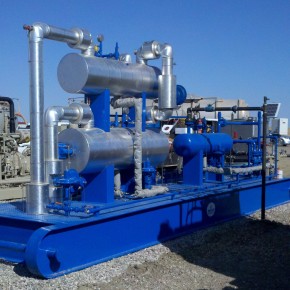
A Horizontal Separator is a cylinder lying on its side. These are the workhorses for high-production wells. Because they are long, they offer a massive surface area for the gas and liquid to interact. This large interface allows gas bubbles to escape the liquid much faster (degassing).
Furthermore, in three-phase applications, the horizontal distance gives water droplets more time to fall out of the oil emulsion as the fluid travels from the inlet to the outlet. If your well produces a high volume of liquid or requires strict oil-water separation, a horizontal unit is almost always the superior choice.
Critical Internal Components | The Guts of the Vessel
A separator is more than just an empty tank. Inside, a series of engineered components work together to force separation.
Inlet Diverter
When the high-velocity stream enters the vessel, it strikes an inlet diverter. This can be a splash plate or a centrifugal device. The impact dissipates the kinetic energy of the stream and initiates the primary separation of bulk liquids from the gas.
Mist Extractor
As the gas rises toward the outlet, it carries tiny mist droplets of oil and water. Before the gas leaves the vessel, it must pass through a Mist Extractor. This is typically a wire mesh pad or a vane pack. As the gas weaves through the mesh, the droplets collide with the wire, coalesce into larger drops, and fall back down into the liquid section. This prevents “carryover”—the dangerous condition of liquid entering the gas line.
Wave Breakers and Vortex Breakers
In long horizontal separators, the flow of fluid can create waves, just like wind on a lake. These waves can disrupt the level controllers. We install wave breakers (baffles) to calm the liquid surface. Similarly, at the drain outlets, we install vortex breakers to stop the liquid from swirling (like a bathtub drain), which prevents gas from being sucked out with the liquid (“blow-by”).
Specialized Applications | Test Vs. Production
Beyond the physical shape, we categorize separators by their function in the field.
Test Separators
A Test Separator is a mobile or dedicated unit used to analyze a specific well. In a field with multiple wells flowing into a common manifold, it is impossible to know how much each individual well is producing. We isolate one well at a time and route it through the test separator. This unit is equipped with high-accuracy meters for gas, oil, and water. It acts as a diagnostic tool, telling us the health of the reservoir.
Production Separator
The Production Separator is the permanent fixture that handles the combined flow of the well or field day in and day out. These are sized for the maximum expected throughput. Unlike test separators, which focus on measurement, production separators focus on bulk processing and reliability.
Troubleshooting Common Issues
Even the best-designed equipment faces challenges. We often help clients troubleshoot two main issues: carryover and blow-by.
Liquid Carryover
This occurs when liquid escapes out of the top gas valve. It is usually caused by a high liquid level (failure of the dump valve), foaming crude, or a plugged Mist Extractor. If not caught, this liquid can destroy downstream compressors.
Gas Blow-By
This is the opposite problem: gas escaping out of the liquid dump valve. This happens if the liquid level gets too low or if the vortex breaker is damaged. Blow-by pressurizes the liquid storage tanks, which can lead to tank ruptures or severe venting emissions.
Call on the Experts of Pro-Gas
The humble separator is the unsung hero of the oilfield. It brings order to chaos, protecting your assets and ensuring that your product meets sales specifications. Whether you require a robust Three-Phase Separator for a liquid-rich Eagle Ford well or a compact Vertical Separator for a gassy Permian application, understanding the nuances of these vessels is key to operational success.
At Pro-Gas, we design our fleet with the realities of the field in mind. We use high-efficiency internals to maximize retention time and prevent carryover. We offer both skid-mounted test units and permanent production vessels to meet every stage of your field’s lifecycle. Don’t let poor separation bottleneck your production.
Are you struggling with liquid carryover or inaccurate well tests? It might be time to upgrade your separation strategy. Contact Pro-Gas today to discuss our inventory of new and refurbished separators. Let us help you select the right vessel to optimize your flow and secure your bottom line.
FAQ
Q. What is the difference between a two-phase and a three-phase separator?
A Two-Phase Separator separates the well stream into two components: gas and total liquid (oil and water mixed). A Three-Phase Separator separates the stream into three distinct components: gas, oil, and water, discharging each through separate outlets.
Q. When should I choose a vertical separator over a horizontal one?
A Vertical Separator is best suited for applications with high gas-to-liquid ratios, where the footprint is limited (such as offshore platforms), or where the flow includes significant liquid slugs. The vertical height helps handle the sudden surge of liquid without flooding the gas outlet.
Q. What is the function of a mist extractor?
A Mist Extractor is a mesh pad or vane pack located near the gas outlet of the separator. Its function is to trap tiny droplets of liquid that are suspended in the gas stream, causing them to coalesce and fall back into the liquid section, ensuring that only dry gas enters the sales line.


