

Posted on: 06. 29. 25

In the dynamic and demanding world of natural gas processing, the pursuit of efficiency is relentless. For engineers and project managers across the Texas energy landscape, the core challenge remains the same: how to maximize the recovery of valuable products, meet stringent quality specifications, and maintain cost-effectiveness.
The answer often lies not in overly complex, capital-intensive machinery, but in the elegant application of fundamental thermodynamic principles. One of the most powerful examples of this is the Joule-Thomson (JT) effect.
For many, the Joule-Thomson effect is a concept from a college physics textbook. In the practical world of gas processing, however, it is a workhorse—a reliable and efficient method for chilling a gas stream simply by reducing its pressure. This chilling process is the key to separating valuable Natural Gas Liquids (NGLs) and achieving the precise dew point control required by pipeline operators.
While the principle is simple, its application in modern gas processing has become highly sophisticated. Today, customizable, skid-mounted JT plants represent the pinnacle of this technology, offering a flexible, efficient, and targeted solution for the diverse challenges of the modern energy sector.
This guide will provide a deep dive into the world of JT skids, exploring the science behind their operation, the immense benefits of custom engineering, and their ideal applications. As a premier Dallas-based engineering and fabrication firm, Pro-Gas specializes in designing and building these tailored JT skid solutions, transforming a basic thermodynamic principle into a powerful tool for operational and financial optimization.
The Science Made Simple: What is the Joule-Thomson Effect and How Does a JT Skid Work?
Understanding the JT skid begins with a clear grasp of the core scientific principle that makes it possible. In essence, the Joule-Thomson effect describes the temperature change of a real gas when it is forced to expand from a higher pressure to a lower pressure without any heat being added or removed from the system. For most gases, including natural gas, this rapid expansion results in a significant cooling effect. A simple, everyday analogy is the cold feeling of an aerosol can after it’s been sprayed; the rapid depressurization and expansion of the contents cause the can and the nozzle to chill.
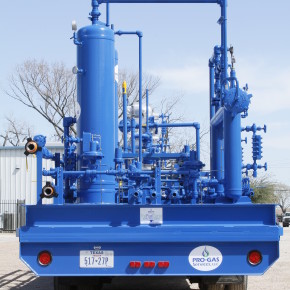
A JT skid is a self-contained, modular plant that is expertly engineered to harness this cooling effect for a specific purpose. It is a masterpiece of thermal efficiency, designed to maximize cooling with minimal energy input. A typical Pro-Gas JT skid consists of several key components working in concert:
- Gas-to-Gas Heat Exchanger: This is the first stop for the high-pressure inlet gas. Here, it flows past tubes containing the already-chilled outlet gas that has exited the main process. This pre-cools the inlet stream significantly, meaning the JT valve has to do less work to achieve the target temperature. This component is a cornerstone of the system’s overall efficiency.
- The JT Valve (Choke): This is the heart of the system. The pre-cooled, high-pressure gas passes through this specialized valve, where a controlled and significant pressure drop is induced. As the gas expands across the valve, the Joule-Thomson effect takes over, causing a rapid and dramatic drop in temperature.
- The Low-Temperature Separator (LTS): The now frigid, two-phase stream (gas and condensed liquids) enters the LTS. In this vessel, the temperature is low enough that the heavier hydrocarbon components (the NGLs like propane, butane, and pentane) and any water vapor have condensed into a liquid state. Gravity takes over, and these valuable liquids collect at the bottom of the separator, while the colder, leaner, and “drier” processed gas exits from the top.
- Control Systems and Instrumentation: The entire process is managed by a sophisticated set of instruments and controls. These components monitor pressure and temperature throughout the skid and precisely modulate the JT valve to maintain the target temperature in the LTS, ensuring consistent performance and optimal liquid recovery.
Beyond the Basics: The Power of Customization in JT Skid Design
In gas processing, there is no such thing as a “standard” gas stream. Compositions, pressures, and flow rates can vary dramatically from one basin to another, or even from one well to the next. This is why a “one-size-fits-all” JT plant is inherently inefficient. True optimization can only be achieved when the system is custom-engineered for the specific conditions it will face. This is where the Pro-Gas philosophy of tailored design provides immense value.
Adapting to Your Unique Gas Composition
A rich gas stream from the Permian Basin, heavy with valuable NGLs, has a very different thermal profile than a leaner gas stream from another play. A standard, off-the-shelf JT skid might recover some liquids from the rich gas, but it will leave significant value behind. Pro-Gas customizes every aspect of the design—from the sizing of the heat exchangers to the geometry of the low-temperature separator—based on a detailed analysis of the client’s specific gas composition. This ensures the skid is perfectly tuned to maximize the condensation and recovery of the most valuable NGL components present in that unique stream.
Optimizing for Pressure Differentials
The magnitude of the cooling effect is directly proportional to the pressure drop across the JT valve. A large differential between the inlet and outlet pressure provides a powerful chilling effect. However, not every application has the same pressure conditions. A wellhead application might have very high inlet pressure, while a fuel gas conditioning application may have more modest pressures to work with.
Our engineers design the system to make the most of the available pressure differential. We can optimize the system to achieve the desired temperature drop with the minimum possible pressure loss, or to maximize the temperature drop when a large pressure reduction is already part of the process.
Achieving Precise Dew Point Control
For producers, meeting the strict quality specifications set by pipeline operators is non-negotiable. One of the most critical specs is the hydrocarbon dew point—the temperature at which liquids will begin to drop out of the gas stream at pipeline pressure. Failure to meet this spec can result in costly penalties or even a refusal by the pipeline to accept the gas.
A custom-engineered JT skid from Pro-Gas is a precision instrument for dew point control. By fine-tuning the operating temperature of the LTS, we can guarantee that the outlet gas will meet or exceed the hydrocarbon and water dew point requirements of any pipeline company.
The Modular Advantage: Why a Skid-Mounted System is Superior
Pro-Gas specializes in fabricating our custom-engineered JT plants as complete, self-contained modular skids. This modern approach to construction offers significant advantages over traditional on-site “stick-building.”
- Accelerated Project Timelines: The entire JT skid is built, assembled, and tested in our controlled fabrication facility in the Dallas-Fort Worth area. This can happen in parallel with any site preparation work, dramatically shortening the overall project timeline from order to startup.
- Enhanced Quality and Safety: A controlled shop environment allows for a higher level of quality control over every weld, fitting, and component. It also provides a safer construction environment compared to the unpredictable conditions of a remote field location.
- Scalability and Redeployment: A modular skid is a flexible asset. As production from a well declines or conditions change, the skid can be easily disconnected, transported, and redeployed to another site where it is needed most, maximizing its economic lifespan.
Ideal Applications: Where Do Customizable JT Skids Shine?
The flexibility and efficiency of customizable JT skids make them the ideal solution for a wide range of applications in the Texas energy sector and beyond.
- Wellhead NGL Recovery: For producers with liquid-rich gas at the wellhead, a JT skid is a perfect tool to strip out valuable NGLs before the gas enters a gathering system. This creates an immediate new revenue stream and often pays for the unit in a very short time.
- Fuel Gas Conditioning: Gas-fired compressors, turbines, and engines require clean, dry fuel gas to operate efficiently and reliably. A JT skid can condition fuel gas by removing liquids and heavy hydrocarbons that can damage equipment, improving combustion efficiency and reducing maintenance costs.
- Dew Point Control for Pipeline Entry: A JT skid can serve as the final “gatekeeper” before a producer’s gas enters a major transmission pipeline, ensuring every molecule of gas meets the required quality specifications.
- Small-Scale and Remote Processing: In many cases, the volume of gas at a particular site may not justify the enormous capital expense of a full-scale cryogenic turbo-expander plant. A JT skid offers a highly cost-effective alternative for achieving significant NGL recovery and dew point control in these smaller-scale applications.
The Pro-Gas Advantage: Precision Engineering for Optimal Performance
The Joule-Thomson effect offers a beautifully simple, elegant, and reliable method for chilling and processing natural gas. However, unlocking the full economic and operational potential of this principle requires more than just a valve and a separator. It requires intelligent, custom engineering that tailors every component to the specific conditions of the gas stream. A customizable, skid-mounted JT plant represents the convergence of thermodynamic efficiency and modern fabrication, offering today’s energy producers a flexible, cost-effective, and powerful tool for maximizing NGL revenue and guaranteeing pipeline compliance.
At Pro-Gas, our strength lies in our comprehensive, in-house capabilities. Our team of experienced engineers in Dallas manages the entire design process, starting with process simulations to model performance based on your specific gas analysis and operational parameters. From there, we create detailed mechanical and electrical designs for a system that is not only thermally efficient but also operator-friendly and easy to maintain.
This detailed engineering package is then handed off to our skilled craftsmen in our state-of-the-art fabrication facility. They bring the design to life, adhering to the highest industry standards, including ASME code for all pressure vessels. This seamless integration of expert engineering and quality fabrication ensures that every JT skid we deliver is a robust, reliable, and precisely customized solution for our client’s unique challenge. We don’t just sell equipment; we deliver a partnership in performance.
Are you facing challenges with NGL recovery, dew point control, or fuel gas conditioning? Don’t settle for a one-size-fits-all solution. Contact the expert engineering team at Pro-Gas today to learn how a custom-designed JT skid can be optimized to meet your specific operational and financial goals.
Frequently Asked Questions
Q. What is the typical range of NGL recovery for a JT skid?
The recovery percentage depends heavily on the gas composition, inlet pressure, and the pressure drop across the JT valve. While a JT plant won’t achieve the high ethane (C2) recovery of a cryogenic turbo-expander plant, it is very effective at recovering heavier NGLs. It is common to achieve 60-70% propane (C3) recovery and over 95% of all butane (C4) and heavier hydrocarbons.
Q. Are JT skids effective for processing low-pressure gas streams?
The effectiveness of a JT skid is directly tied to the pressure drop available. If the inlet pressure is low or the required outlet pressure is high, the small pressure drop will produce only minimal cooling. In these low-differential scenarios, other technologies like mechanical refrigeration units (MRUs) are often a more effective solution. JT skids perform best in applications with significant available pressure drops.
Q. What is the main difference between a JT plant and a cryogenic turbo-expander plant?
The main difference is the method of cooling and the level of cold achieved. A JT plant uses a valve for passive pressure reduction to achieve temperatures typically in the -20°F to -50°F range. A cryogenic plant uses a turbo-expander (a turbine) to rapidly expand the gas, which performs work and achieves much deeper cryogenic temperatures (often -120°F or colder). This allows cryogenic plants to recover a high percentage of ethane, while JT plants are focused on propane and heavier NGLs. JT plants are less complex and have significantly lower capital and operating costs.
Q. How much operator attention does a modern, automated JT skid require?
Very little. A modern JT skid from Pro-Gas is designed for highly automated, reliable operation. With pneumatic or electronic controls managing the process and maintaining the target separator temperature, daily operator attention is typically limited to routine checks of gauges and fluid levels. This significantly reduces manpower requirements compared to more complex processing plants.


